

Reading time
8 minutes.
TL & DR
- Partnership & purpose: Titan Network is partnering with Gateway.fm to power Titan's chain ops (validators, nodes, observability) as it approaches mainnet, adding reliability and Polygon-stack optionality alongside its Cosmos base.
- Why Gateway for DePIN: DePIN ≠ typical dApps have continuous, high-volume on-chain activity from millions of devices need enterprise-grade uptime. Gateway brings 99.999% SLAs, globally distributed smart-cached RPCs, 24/7 monitoring (100+ metrics), and automatic zero-time failover.
- Titan's traction & model: Titan delivers last-mile infrastructure (CDN, IP leasing, web data collection, edge) with 28+ enterprises using Titan CDN and 4M+ registered devices across testnets. Anyone can contribute via a 2-click app/extension and earn transparent rewards.
Speakers
- Paul (Titan) - Host, Titan Network
- Konstantin (Titan) - Co-founder & Chief Strategy Officer, Titan Network
- Daniel (Gateway) - Business Development, Gateway.fm
Paul (Titan):
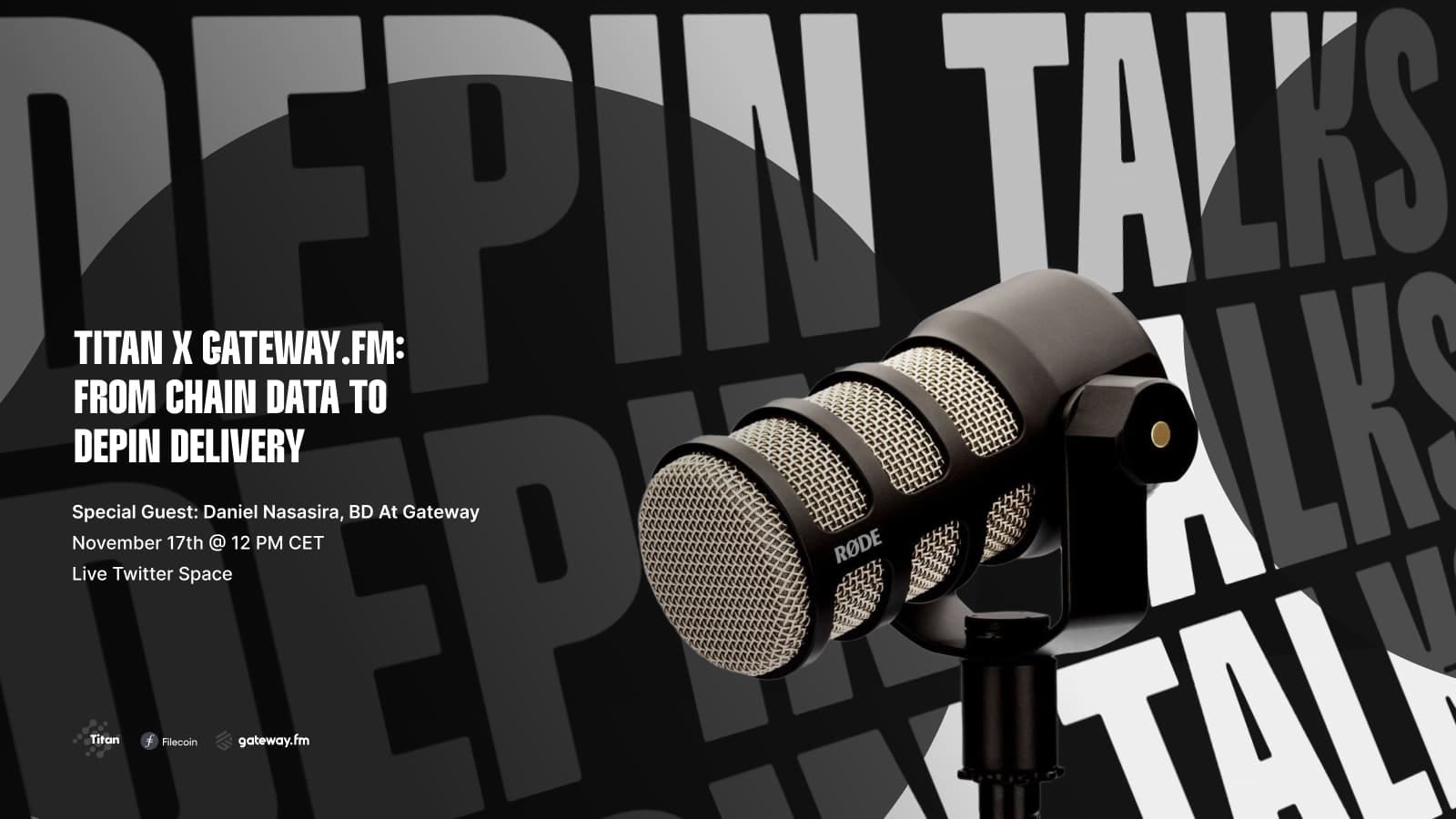
Welcome, fam. Welcome Crypto Twitter. Welcome, everyone around the world. This is DePIN Talks #4. Today, we're talking about decentralized physical infrastructure in production, and specifically our new collaboration between Gateway.fm and Titan Network. What it is and why it matters. If you follow us on socials, you probably saw the announcement two weeks ago. Let's start there.
For anyone meeting you for the first time, Daniel: What is Gateway.fm in a sentence or two, and what problems are you obsessed with solving?
What Gateway.fm Does
Daniel (Gateway):
Hi, everyone. I'm Daniel from Gateway, on the BD team, and it's a pleasure to join the Titan community today.
Gateway.fm specializes in building and operating enterprise-grade blockchain infrastructure, including rollups, Layer 2s, Layer 1s, RPCs, indexers, and a comprehensive suite of tooling. Our goal is straightforward: to enable teams to launch and scale production networks without worrying about the underlying platform. We take care of the infrastructure so teams like Titan, Lumia, Status, and others can focus on their products and business.
Paul (Titan):
Amazing, i am a big fan of what you do. We've followed your work since you collaborated with Lumia and across the broader Web3 space. We're excited to build together in DePIN as well.
Titan Network in a Nutshell
Paul (Titan):
Konstantin, quick refresher for newcomers, including folks coming from the Gateway side, what is Titan Network?
Konstantin (Titan):
Great to be here, and Daniel, likewise, we're excited about this collaboration. Gateway is one of the most impressive technical teams we've worked with in crypto.
For anyone new: Titan Network enables people to share idle resources and earn rewards from devices they already own. If you have a phone, laptop, desktop, IoT device, or even data-center-grade hardware, you can connect it to Titan.
We aggregate those resources and rent them to enterprise clients. You install our app or browser extension in just a couple of clicks, and you earn passively while Titan handles orchestration, enterprise demand, and partnerships.
Because we serve both enterprise customers and a large community of resource providers, reliable infrastructure is critical.
That's where Gateway.fm comes in, and why we're excited about this technical collaboration.
How the Collaboration Started
Paul (Titan):
Let's zoom out. How did this collaboration begin? Any "aha" moment where it was obvious you should work together? Konstantin first, then Daniel.
Konstantin (Titan):
We first crossed paths with the Gateway team at a conference while we were actively evaluating the most reliable infrastructure options. Titan is built on the Cosmos SDK, but we wanted an additional layer of security and reliability - and optionality - by integrating with another blockchain stack.
Gateway's deep support for the Polygon ecosystem stood out. Like many conference collisions, we started tinkering with how we could help each other and quickly realized there was a lot more to build together. As Daniel mentioned, we want to focus on scaling our services and delivering quality to enterprises and our community. Offloading some chain operations to a specialized partner makes a ton of sense. That was the "aha."
Daniel (Gateway):
That's exactly it. Shout-out to Bash on our side for the initial connection. In general, teams quickly realize there's significant complexity and cost in maintaining infrastructure.
Moving to a specialized rollup-as-a-service or infra partner like Gateway helps projects shed operational overhead.
From our first conversations with Titan, it was obvious we could reduce complexity and costs while helping them stay focused on delivering value to their enterprise customers.
What Titan Is Moving to Gateway
Paul (Titan):
Konstantin, which parts of Titan's stack will rely on Gateway solutions right now?
Konstantin (Titan):
We're kicking off the collaboration by planning to move core blockchain components to Gateway.fm node operations, validator set support, and stability/observability tooling.
This is hand-in-hand work as we approach mainnet: smooth transitions from testnets to mainnet, soft-launch safeguards, and battle-tested reliability.
We'll expand Gateway's role over the coming months as we finalize our ecosystem launch. The community is excited about mainnet, and so are we.
Why DePIN Infra is not a Typical dApp Infra
Paul (Titan):
Daniel, a lot of DePIN teams are software built on decentralized infrastructure. How is serving a DePIN protocol different from serving typical decentralized applications?
Daniel (Gateway):
DePIN is a completely different beast. A typical dApp might have periodic traffic spikes - mints, governance votes, etc. A DePIN network like Titan has continuous activity: tens or hundreds of thousands of nodes registering, submitting proofs, validating SLAs, and earning rewards - every minute.
That changes how we support them.
We focus on scale and reliability:
Titan has huge numbers of active nodes, each effectively acting like an individual wallet. Your infra must scale horizontally to handle sustained transaction volumes from millions of potential resource providers.
Uptime is non-negotiable. If Titan's chain goes down, CDN, data sharing, and rewards stop, breaking the economic incentives. So we treat Titan as a tier-one, mission-critical client.
Practically, that means globally distributed, smart-cached RPCs and guaranteed SLAs with the highest availability we can offer.
Konstantin (Titan):
Fully agree. We manage a decentralized edge with millions of potential nodes, so the engineering problem is very different. As of now, across testnets, we've seen 4M+ registered devices in the Titan ecosystem. The on-chain backbone must handle massive throughput to support last-mile compute and delivery services - CDN, IP leasing, web data collection, and more.
Hosting these use cases on decentralized infrastructure requires a robust on-chain data backbone. That's how we ensure the service layer we deliver to enterprises and our community is on par with traditional cloud.
How a Robust Chain Backbone Changes Enterprise Offerings
Paul (Titan):
Konstantin, Titan focuses on last-mile compute and delivery CDN, IP leasing, web data collection, and edge infra. How does a robust on-chain backbone change what we offer enterprises?
Konstantin (Titan):
We compete directly with Web2 cloud giants on quality. From the customer's perspective, it must be easier and better to run on Titan than elsewhere. Our approach is to identify the most painful cloud problems and offer cheaper and more reliable alternatives - without added complexity.
That's how Titan's business started with CDN testnets early this year. Today, 28+ enterprises use Titan CDN daily. We've always aimed for high-quality services, and we benchmark ourselves against providers like Google Cloud and AWS.
Importantly, decentralized edges aren't just "good enough"; they can be better for time-sensitive workloads. Having tens of thousands of nodes globally improves coverage and proximity. The closest possible "data center" is actually the user's device or devices near them. That proximity boosts performance for CDN and IP leasing in ways centralized footprints can't always match.
A reliable chain backbone run with a partner like Gateway adds transparent metering and payouts, and the trust enterprises require. For DePIN, last-mile compute and delivery are the future.
Getting Started with Gateway: A Builder's Path
Paul (Titan):
Daniel, if a project wants to rely on Gateway for on-chain access, what's the simplest production-safe setup, and where should they start?
Daniel (Gateway):
We've deployed 2,000–3,000 rollups and work with enterprises like Ernst & Young (EY), Microsoft, and teams like Titan, Lumia, Status, and more.
The fastest way to get started is Presto, our Rollup-as-a-Service platform. Presto lets teams spin up a chain in ~10 minutes, then test, break, and scale without touching the underlying infra. We typically start projects with a DevNet, then move to testnet and mainnet once contracts, integrations, token flows, and core logic are validated.
Reliability, Monitoring, and Failover
Paul (Titan):
How do you measure and guarantee reliability for protocols that can't go down, like DePIN networks? What does your monitoring and failover look like?
Daniel (Gateway):
Three layers:
- SLAs: We back reliability with 99.999% uptime SLAs. We run a globally distributed node network with intelligent routing and smart caching so users hit the nearest, fastest, most reliable endpoint - 24/7/365.
- Monitoring: We track 100+ metrics - latency, alerts, node health, capacity, and more - to detect issues before they're user-visible (e.g., a node nearing capacity). Our 24/7 team can intervene proactively.
- Failover: We implement automatic, zero-time failover. If a node or region degrades, traffic is instantly rerouted to a healthy node/region. For DePIN projects like Titan - with users and devices worldwide - failover must be invisible.
Trends & Roadmap: The Next 1–2 Years
Paul (Titan):
Daniel, what on-chain infra trends are you most excited or worried about over the next year or two, especially for DePIN?
Daniel (Gateway):
I'm excited about aggregated liquidity. Our partnership with Titan leverages the Polygon AggLayer, which is a great example. Many DePIN protocols are isolated; AggLayer enables native liquidity sharing across chains. I'm bullish on unified liquidity as a growth engine for DePIN.
Konstantin (Titan):
I share that view that cross-network, cross-chain collaboration is accelerating. Hosting DePIN Talks (this is #4), we've brought together infra providers and DePIN leaders like Fluence, and our co-hosts include Filecoin, a major player in the space. Big kudos to that community.
What excites me most is the industry shift from raw resource aggregation to service-grade offerings.
DePIN is maturing: we're not just exposing infrastructure; we're delivering high-quality cloud services (CDN, IP, scraping, edge compute) with clear revenue loops. We're moving from "here's capacity, figure it out" to "here's a production-ready service with measurable outcomes." With critical mass and volume - including projects like Helium - the next two years will be about services at scale.
Wrap-Up
Paul (Titan):
Looks like our Discord chat is buzzing about this collaboration. Daniel, thanks for joining and sharing insights on DePIN and our Gateway.fm × Titan partnership. Konstantin, as always, thank you for the deep dive.
Daniel (Gateway):
Thanks for having us and for welcoming Gateway into the Titan community. We're excited to build together and see where this goes.
Konstantin (Titan):
Likewise. If you want to participate, install the Titan app or browser extension - two clicks - and start earning by contributing your device. Stay tuned for mainnet.
Paul (Titan):
Thanks, everyone. See you next time!