

Estimated Reading Time
23–25 minutes
TL&DR
- DePIN is growing up: the space is shifting from token-first hype to revenue-first, enterprise-ready services with real users and real demand.
- Revenue beats narrative: sustainable business models, paying customers, and consistent growth now matter more than speculation or community hype.
- Connectivity is core infrastructure: bandwidth and decentralized connectivity are emerging as critical digital resources, potentially rivaling energy in importance.
- The best crypto is invisible: successful Web3 and DePIN products will win by delivering better experiences, not by emphasizing blockchain or crypto itself.
Host: Konstantin Tkachuk
Guest: Anthony Francis (Cointelegraph Accelerator)
Opening
Konstantin Tkachuk:
Hello everyone, it’s a pleasure to be here.
Anthony, are you here with us today?
Anthony Francis:
GM, GM, I’m here. How are you doing?
Konstantin Tkachuk:
Wonderful. It’s a busy week on Titan Network. I hear Paul might also be joining us, so everything is going as expected.
How’s life going for you? How is everything at Cointelegraph, and how is the year wrapping up?
Anthony Francis:
It’s been a fantastic year. I’m very excited about everything we were able to accomplish this year, and also very excited about what you guys at Titan have built.
The holiday season is busy up here in Canada — we’re getting hit with heavy snow and extreme cold. It’s a pretty intense way to wrap up the year.
Konstantin Tkachuk:
Totally. And hello to everyone joining us from around the world — whether it’s snowing, raining, or windy. I hope everyone is safe, warm, and enjoying time with family and friends as the holidays approach.
Introduction to DePIN Talks
Konstantin Tkachuk:
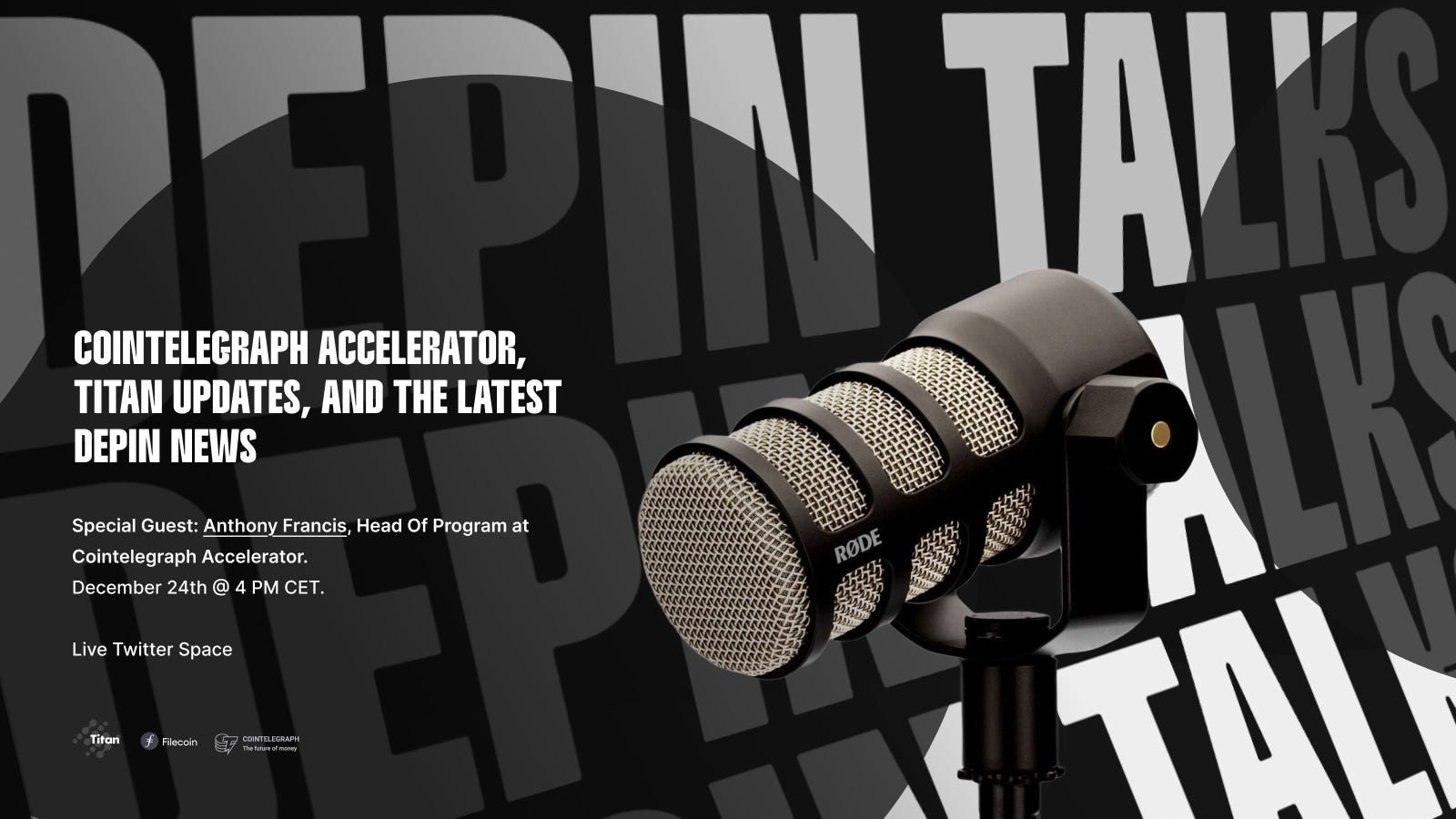
Today we’re hostingDePIN Talks, an initiative by Titan Network. The goal is to explore what’s happening in the DePIN space, who’s contributing, what’s being built, and how decentralized infrastructure is evolving.
We’re very excited to have Anthony from Cointelegraph with us today to share insights on DePIN and the Cointelegraph Accelerator.
Cointelegraph Accelerator Overview
Konstantin Tkachuk:
Titan Network recently joined the Cointelegraph Accelerator.
Anthony, could you explain what the accelerator is, what types of projects you support, and what builders should look for?
Anthony Francis:
Absolutely.
The Cointelegraph Accelerator is a vertical within Cointelegraph. As a company, Cointelegraph has massive reach, exposure, and credibility in the space, and the accelerator was created to bring that value directly to startups.
What we offer includes marketing and PR expertise, strategic advisory, and selective venture investment. We’re not a traditional VC — we don’t lead rounds and we don’t invest pre-seed. We focus on early to mid-stage startups, typically from seed to Series A, that already have traction.
We want to see strong teams, prior fundraising completed, and a clear go-to-market timeline. Our sweet spot is about 12 to 18 months before a TGE or product launch, and we continue supporting teams well beyond that.
We’re fairly agnostic across verticals, but we generally stay away from gaming. It’s a difficult industry with high capital requirements and low success rates.
What really matters to us are three fundamentals:
First, a viable Web3 integration — blockchain needs to make sense in the business model.
Second, a sustainable business model with real revenue potential.
Third, strong underlying technology and innovation.
Our acceptance rate is extremely low because our due diligence is very thorough. But once a project joins, we’re deeply hands-on. We work closely with founders, act as an extension of the team, and support them through go-to-market and beyond.
Personal Investment Interests
Konstantin Tkachuk:
From a personal perspective, are there any types of projects you particularly enjoy seeing in the accelerator?
Anthony Francis:
My interests are pretty broad.
DePIN is definitely one of the areas I’m most excited about, which is why we consider it such a strong vertical. DeFi is another — I think it represents a fundamental shift in finance, and what we’re seeing now is the convergence of DeFi and TradFi into what will eventually just be on-chain finance.
AI is also very interesting to me. I’m cautious about it from an investment standpoint, but when AI truly solves a meaningful problem at scale — especially when paired with DePIN — it becomes very compelling.
Titan Network & Bandwidth as Infrastructure
Konstantin Tkachuk:
At Titan, we’re building decentralized cloud infrastructure, CDN, IP leasing, and web scraping, all powered by community bandwidth.
We believe bandwidth is becoming a new form of digital gold. Without connectivity, modern life stops banking, payments, AI access, and communication. DePIN enables people to monetize resources they already pay for, while providing enterprises with scalable infrastructure.
What Makes Teams Successful
Konstantin Tkachuk:
From your experience, what distinguishes the teams that succeed in the accelerator?
Anthony Francis:
There are clear indicators.
From a business perspective, it comes down to proper use of Web3 technology and a viable, revenue-generating business model.
From a people perspective, passion is the biggest factor, real passion for the problem being solved, not excitement about valuation or exits. You can hear it in how founders talk.
Other important traits include strong work ethic, communication, professionalism, and a hunger for learning. Founders who constantly educate themselves and adapt quickly tend to succeed.
DePIN Trends and the Road to 2026
Konstantin Tkachuk:
What DePIN trends do you see accelerating now, and what do you expect to be important in 2026?
Anthony Francis:
Speculation-driven hype is fading, and low-revenue verticals are struggling.
What’s accelerating is connectivity and bandwidth. I believe connectivity will become one of the most valuable digital resources, second only to energy.
Wireless and decentralized connectivity are critical. Compute is interesting, but I think large enterprises will dominate that space. Startups have better opportunities innovating around bandwidth and services.
Another emerging trend is middleware, which provides end-to-end solutions rather than just raw infrastructure.
Traction, Revenue, and Enterprise Readiness
Konstantin Tkachuk:
How do you distinguish a strong story from a real, enterprise-ready business?
Anthony Francis:
Traction.
We don’t invest at the idea stage. We look for real users, paying customers, and consistent growth patterns. Revenue is the clearest signal of product-market fit.
We also value teams that can pivot quickly, listen to customers, and adapt. Falling in love with a single idea without flexibility is a common failure mode.
Enterprise vs Retail Adoption
Konstantin Tkachuk:
Is enterprise adoption necessary to succeed today, or is smaller-scale traction enough?
Anthony Francis:
Enterprise adoption isn’t required, but it’s an advantage.
Small businesses, startups, or retail users are perfectly valid if they demonstrate real value and scalability. Enterprise customers provide strong social proof, but they’re not mandatory.
Beyond the Web3 Bubble
Konstantin Tkachuk:
Have we outgrown the phase of building only for crypto-native users?
Anthony Francis:
Absolutely.
Crypto is a tiny fraction of the global population. You can’t build just for Web3 insiders. Winning products hide blockchain complexity and deliver seamless experiences.
End users don’t care about the rails, they care about outcomes.
Rapid-Fire Questions
Konstantin Tkachuk:
What’s one thing teams misunderstand about accelerators?
Anthony Francis:
Accelerators exist to create value for startups, not extract it. If they’re extractive, the model is broken.
Konstantin Tkachuk:
What’s one headline to watch in DePIN in 2026?
Anthony Francis:
Large, unexpected enterprises entering the DePIN space, especially in energy, real estate, and infrastructure.
Konstantin Tkachuk:
What metric proves DePIN works at scale?
Anthony Francis:
Revenue and revenue growth.
Konstantin Tkachuk:
What’s one mistake founders repeat when scaling?
Anthony Francis:
Timing hiring too early, scaling too fast, or going to market at the wrong moment.
Closing
Konstantin Tkachuk:
Thank you, Anthony, for an incredible conversation.
The takeaway is simple: build the right thing, at the right time, for the right audience.
Thanks to Cointelegraph Accelerator, Titan Network, and the Filecoin ecosystem for supporting DePIN Talks.
We’re wrapping up 2025, spend time with family, recharge, and get ready for an exciting 2026.
Thank you everyone for joining us.