

Reading Time
5 minutes
TL&DR
- DePIN (Decentralized Physical Infrastructure Networks) lets people share idle storage, bandwidth, or compute to power digital services and earn crypto rewards.
- It reduces costs, expands global access, removes single points of failure, and gives individuals ownership in internet infrastructure.
- Titan Network makes DePIN easy and scalable through tools for storage, IP leasing, and compute rentals, paying users in $TNT for real verified contributions.
Introduction: From Corporations to Communities
For most of the internet's history, only large tech companies had the resources to build and control the infrastructure it runs on. Data centers, server farms, and bandwidth acted as the backbones of the internet.
These systems have become increasingly expensive, centralized, and largely invisible to the average person. Have you ever heard of Amazon Web Services, Microsoft Azure, or Google Cloud Platform?
These are the world's largest centralized physical infrastructure networks that make every website, text message, email, and AI prompt a reality.
But, what if your old laptop or personal device could help power the internet? And what if you could lease your unused bandwidth to TikTok to help deliver videos around the world? Or lease some of your unused storage to an AI enterprise, and what if you got paid for doing it?
That's the idea behind Decentralized Physical Infrastructure Networks. It's a new class of Web3 technologies where everyday people contribute to providing infrastructure for the digital world by leasing their unused resources in exchange for rewards from global enterprises that are looking to save money on reliable, safe and secure web services.
In this guide, we'll cover:
- What DePIN actually is
- Why it matters
- How it works
- Where it's already being used
- How platforms like Titan Network are helping shape the future
1. What DePIN Actually Is
The internet runs on infrastructure: storage servers, bandwidth, computers, and more. This infrastructure is traditionally owned and operated by a few large corporations.
DePIN, or Decentralized Physical Infrastructure Network, is a new approach. It enables everyday people to contribute real‑world resources like their idle storage, unused internet bandwidth, or spare processing power to help run digital services. In return, contributors earn crypto rewards. It's a bottom‑up, blockchain‑powered alternative to centralized infrastructure.
Think of it as Airbnb for the internet's backend: instead of renting out spare rooms, you rent out digital resources and get paid. DePIN is part of the broader Web3 movement, which aims to decentralize not just ownership of assets (like tokens or NFTs), but also the infrastructure that powers the internet and is attached to all of our digital web enabled devices.
The Internet's Evolution: Web1 → Web2 → Web3 → DePIN
Let's zoom out.
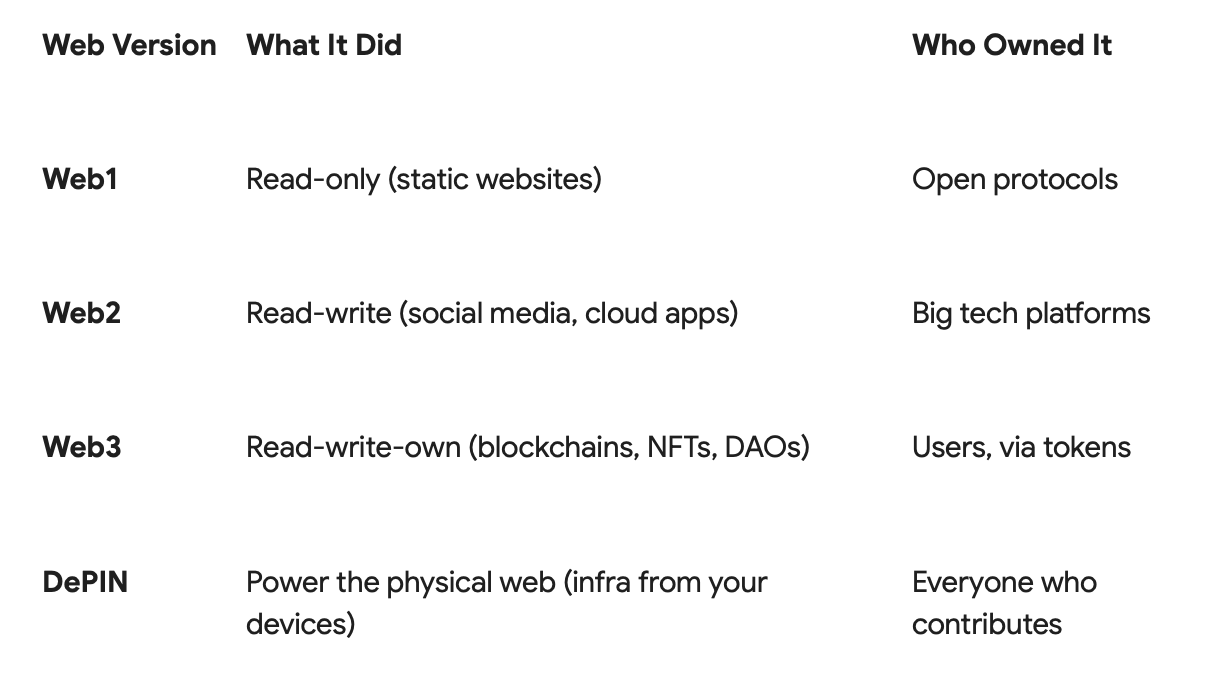
Web3 brought ownership to digital assets. DePIN brings ownership to digital infrastructure.
2. Why It Matters
Infrastructure is the backbone of the internet. It includes:
- Storage (e.g., AWS, Google Cloud)
- Compute power (used by AI, gaming, apps)
- Network access (bandwidth from ISPs, 5G towers)
- Connected devices (personal devices, sensors, routers, IoT systems)
Beacuse most of that infrastructure is owned by a few corporations. They control the servers. They rent the access. And they profit from the demand.
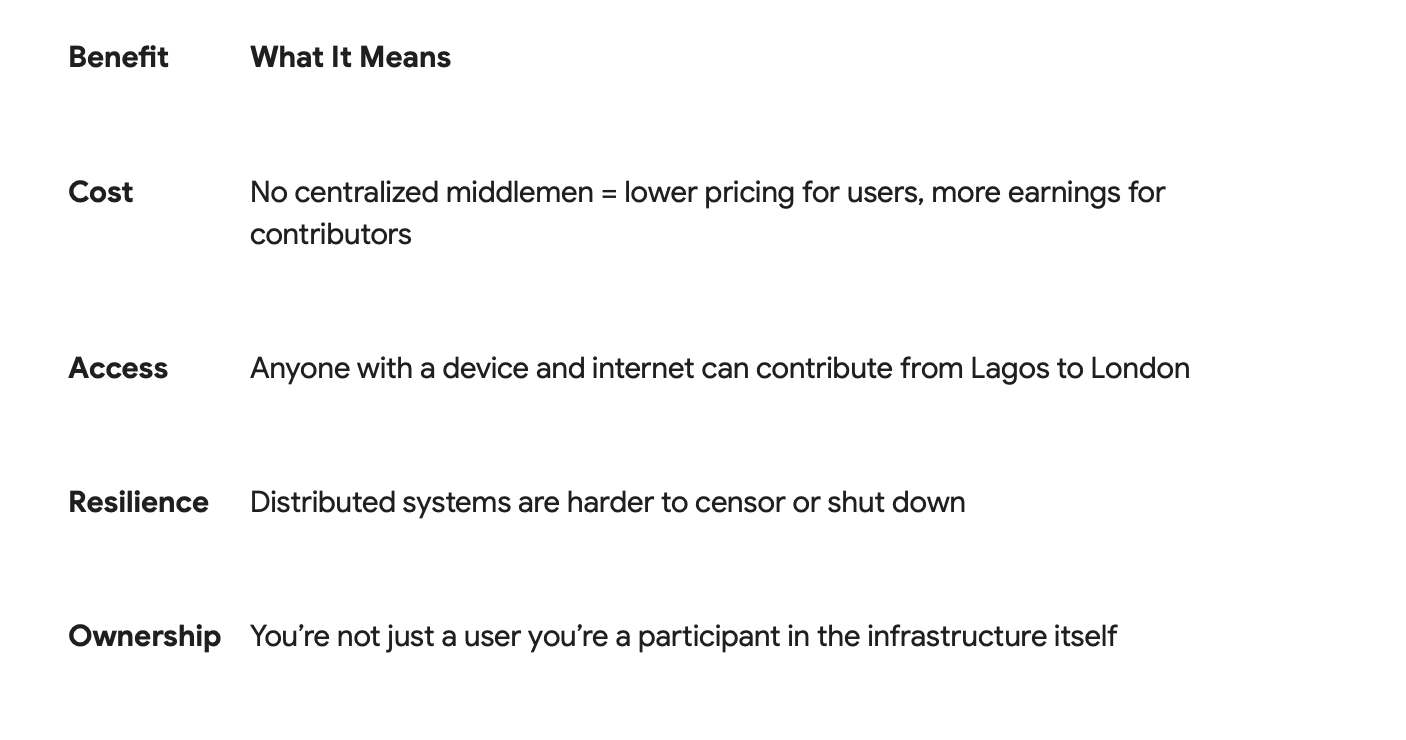
This creates several problems:
- High Costs: Cloud services can be prohibitively expensive.
- Limited Access: Infrastructure is concentrated in wealthier regions, leaving gaps elsewhere.
- Single Points of Failure: One outage can impact millions of users.
- Lack of Personal Ownership: Users have no stake in the systems they rely on.
DePIN addresses all of these issues. It reduces costs, increases global access, builds resilience, and gives contributors a real economic role in powering the internet.
3. Traditional Infrastructure vs DePIN (Examples)
Let's make this real:
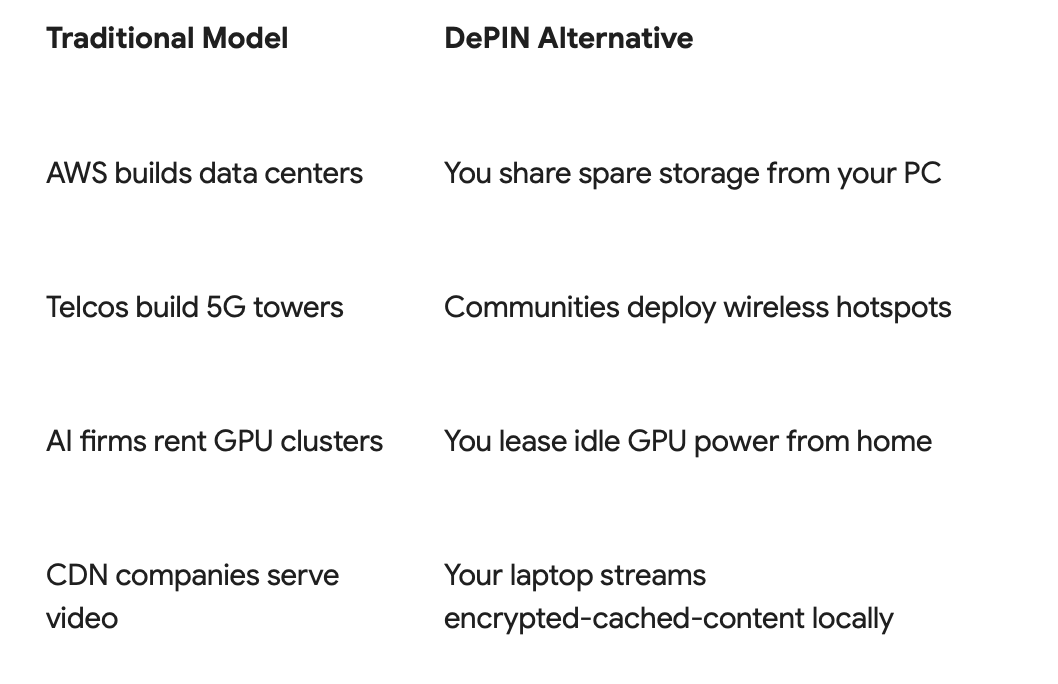
The model is shifting from corporate‑owned warehouses to user‑powered networks.
4. How It Works
Here's how a typical DePIN platform functions:
- Install a secure app like a lightweight application or browser extension
- Choose what to share idle bandwidth, storage, or processing power
- Your device becomes a node in the network available to perform tasks
- The network assigns jobs like storing files, routing traffic, or executing compute tasks
- The blockchain tracks usage and performance ensuring transparency and accountability
- You earn token rewards for your verified contributions that you can keep or exchange for alternative currencies.
These networks are open, peer‑to‑peer, and performance‑driven. You only earn for what you actually provide no speculation, just utility. Blockchain is used not for hype but for coordination, verification, and rewards distribution.
5. Where It's Already Being Used
DePIN isn't theoretical, it's already running across millions of devices globally:
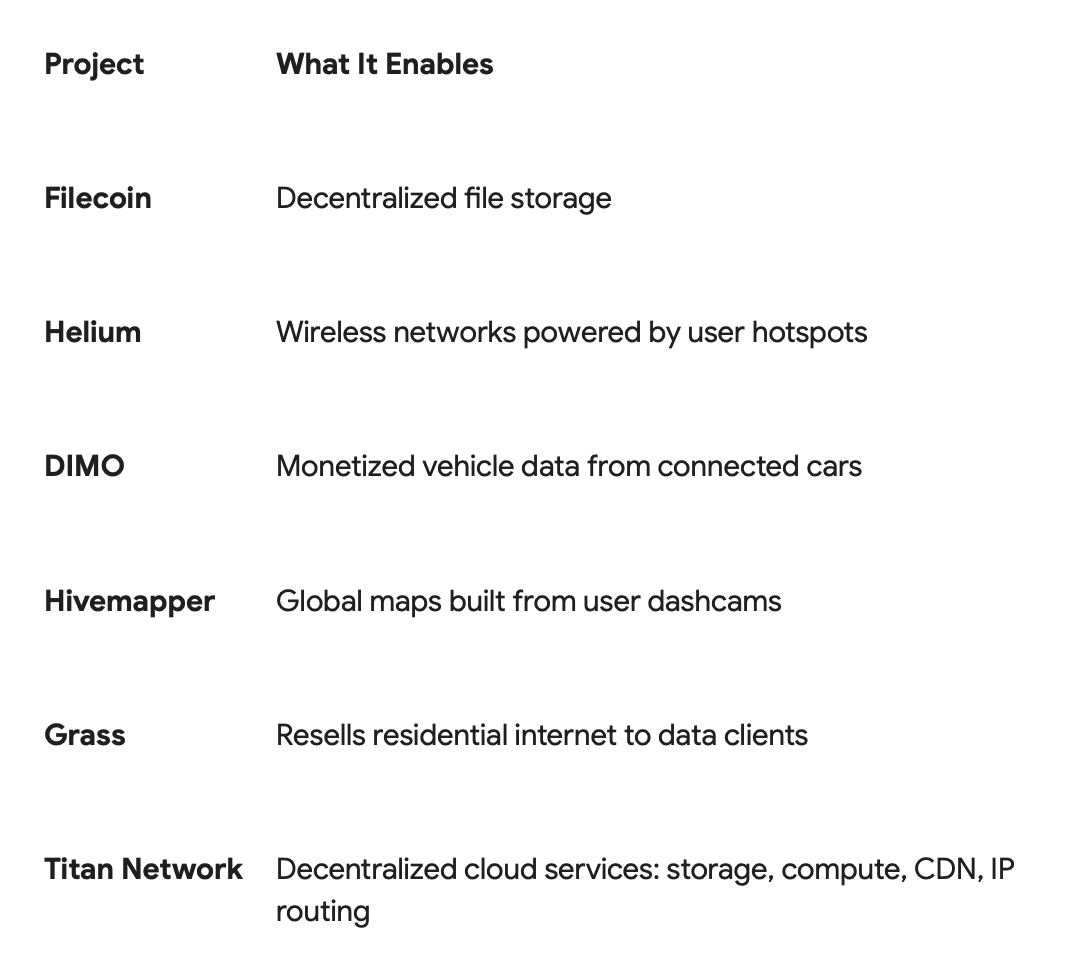
These platforms are already serving real companies, real users, and real demand, often at a fraction of the cost of traditional cloud.
DePIN is especially powerful in:
- Emerging markets (where cloud access is limited)
- Edge computing (where low‑latency is critical)
- AI workflows (where GPU power is scarce and expensive)
It sits at the intersection of major global shifts:
- Surging demand for AI and edge compute
- Rising cloud costs across the board
- Gaps in infrastructure in emerging markets
- A growing appetite for privacy, ownership, and passive income
It's not just a trend; it's a structural change in how the internet runs.
6. How Platforms Like Titan Network Are Shaping the Future
Titan Network is a prime example of how DePIN can be made accessible, efficient, and scalable.
Here's what Titan offers:
- Storage Nodes: Run on personal or enterprise devices to host decentralized files
- Edge Browser Extension: Lets users lease unused IP addresses securely
- Compute Rentals: Allows AI tasks and edge apps to run on distributed user devices
- Tokenized Rewards ($TNT): Paid based on real usage, tracked transparently on‑chain
Titan focuses on usability making DePIN participation simple for individuals, while offering enterprise‑grade services for companies.
It's already helping power:
- AI infrastructure
- Video content delivery
- Cloud file storage
- Global IP routing
Titan isn't just part of DePIN; it's helping define what decentralized infrastructure can look like at scale.
Final Thoughts: The Next Layer of the Internet
For decades, digital infrastructure was owned and controlled by a few major corporations. Now, DePIN is enabling a new model one where anyone can contribute, anyone can earn, and everyone can benefit.
Whether you're a developer, a creator, a builder, or simply someone with a decent laptop and internet connection, you can be part of the next phase of the internet.
This is more than a trend. It's a shift in how the internet is powered from the bottom up.
Welcome to DePIN. Welcome to the infrastructure you own.