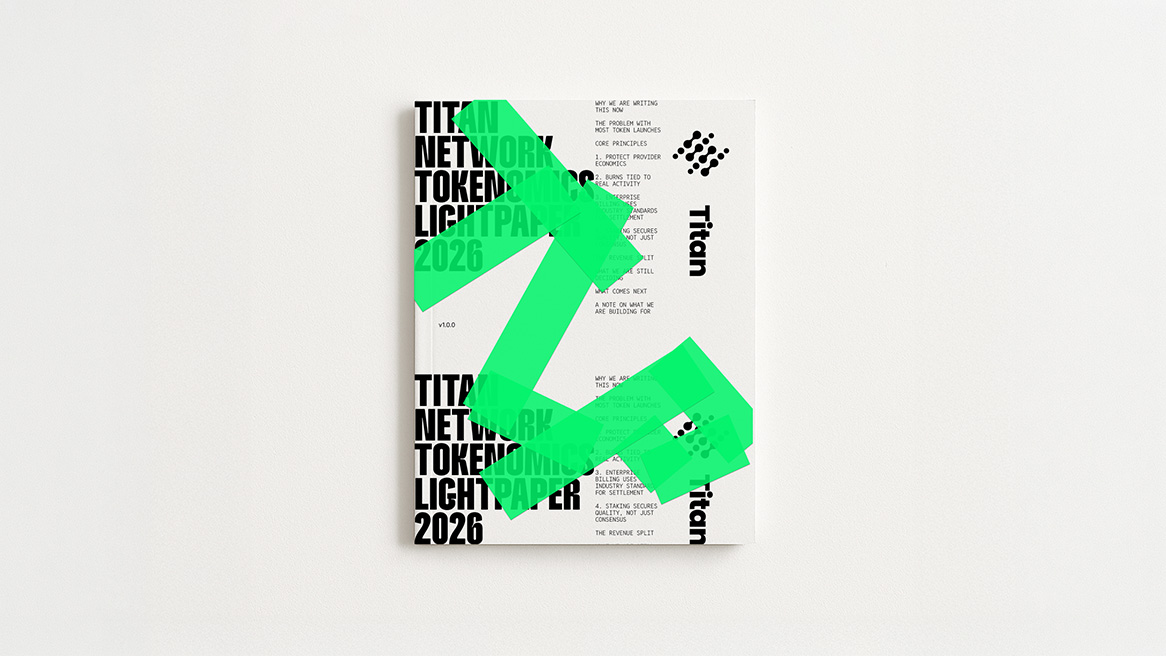


Why We Are Writing This Now
Six months ago, we shared our internal Tokenomics Executive Summary with early partners, investors and advisors. Since then, we have stress-tested assumptions, modeled edge cases, and listened to feedback from selected resource providers who actively contribute to Titan Network today. This post is our first public update on where the $TNT token economy stands as we build towards the mainnet.
We are not publishing final numbers today. Some parameters are still being calibrated, and we would rather get them right than rush them out. What we are sharing is the architecture — the core principles, the mechanisms, and the reasoning behind them. If you are contributing resources, utilising resources or building on Titan, this is the framework that will govern how value moves through the network.
The Problem with Most Token Launches
2025 was a brutal year for new tokens. Roughly 85% of tokens launched last year are trading below their initial valuations, with the median down over 70%. The pattern was consistent: inflated FDV at launch, broad airdrops to short-term traders, thin utility, and persistent sell pressure from insiders and providers dumping to cover costs.
DePIN projects face the same problem. Several infrastructure tokens launched with aggressive emissions, paid providers entirely in their native token, and then watched as those providers sold immediately to pay electricity bills and bandwidth costs. The result was deadly for many: provider selling cratered the token price, which reduced the USD value of rewards, which drove providers to leave the network, which reduced service quality, which killed the project.
We studied these rises and falls closely. Three things went wrong repeatedly:
- No revenue link. Token value was decoupled from actual network usage. Rewards came from inflation, not from customers paying for services.
- Provider sell pressure was ignored. When 100% of provider compensation is in a volatile token, providers must sell to survive.
- Overpromise on day one. Teams locked in rigid tokenomic parameters before they understood real demand, then couldn’t adapt when conditions changed.
The Titan tokenomic design is built to avoid all three.
Core Principles
1. Protect Provider Economics
Resource providers run the infrastructure. If they can’t cover operating costs, they leave. When enough providers leave, service quality drops and customers follow. We have watched this play out at other DePIN projects in real time.
Our recommended approach is Dual Compensation: a portion of provider revenue paid in stablecoins (covering OpEx directly), with the remainder converted to TNT. This means providers aren’t forced to sell the majority of their TNT rewards just to keep the lights on. In our modeling, Dual Compensation reduces provider sell pressure by 3-4x compared to full-token payout models.
The exact split will be governed by network parameters that can be adjusted as the ecosystem matures. The point is structural: we have designed the system so that provider survival doesn’t depend on token price.
2. Burns Tied to Real Activity
We are exploring multiple burn mechanism for TNT. The specifics — whether burns are fixed-percentage, algorithmic (targeting issuance neutrality), or layered with reserve buffers — are still under evaluation. What’s decided is the intent: burned tokens come from actual service revenue, not from artificial mechanisms. Burns should make the token economy healthier, not just create a marketing narrative.
We have modeled four distinct approaches, ranging from simple fixed burns to a multi-layered system that prioritizes provider stability reserves before burning surplus. Each has trade-offs. We will publish the final model with full simulation data before mainnet.
3. Enterprise Billing Uses Industry Standards For Settlement
Enterprises pay in USD. Period. They maintain accounts denominated in stablecoins, and resource provider daily settlement will need to link TNT to USD in order to calculate the full compensation. This means enterprise customers aren’t expected to buy, hold, or even think about TNT directly. They get a predictable cost structure. The protocol handles conversion.
This matters because most enterprises won’t sign a compute contract priced in a volatile token. By separating the billing layer from the token layer, Titan can compete on price and reliability against traditional cloud providers without asking customers to take on crypto risk.
4. Staking Secures Quality, Not Just Consensus
Staking in Titan isn’t purely about block production. We are designing a system where stakers help verify the quality of service that resource providers actually deliver.
Checker nodes can create utility by staking TNT and validating that providers meet their SLA commitments: bandwidth, uptime, latency. Providers caught delivering poor quality face slashing of their collateral. Checkers who misreport face slashing too. Both sides have something to lose, which is the point.
We are also exploring deal collateral for providers: optional TNT lockups that signal commitment to specific service contracts. Providers with collateral get priority in scheduling for higher-value deals. This doesn’t add inflation. It’s a security deposit that ensures network quality, not a simple DeFi yield farm.
The Revenue Split
When enterprise customers pay for Titan services, the current revenue is split:
- 80% to resource providers — the people actually running infrastructure.
- 20% to protocol operations — covering protocol development, treasury and operations reserves.
This split on testnets is a starting point. Mainnet launch and then governance (once activated post-launch) can adjust it. But the principle is that the vast majority of revenue should flow to the people doing the work.
What We Are Still Deciding
We want to be direct about what’s not finalized:
Chain selection. Mainnet will most likely be deployed within the Ethereum ecosystem. The specific chain (L2 or otherwise) is being evaluated based on cost, throughput, and developer tooling. We will announce when the decision is made.
Initial circulating supply at TGE. We have modeled a range, but the final number depends on market conditions, exchange requirements, and community feedback. We won’t commit to a number until we are confident it’s right.
Governance model. We’re evaluating options including veTNT (vote-escrowed) and standard TNT governance. Governance will be modular and isolated from the billing system, activating some period after mainnet launch. We want the network running and stable before governance goes live.
Exact token split percentages. As described above, the mechanism is designed but not parameterized. We will publish simulations and a parameter proposal for public review before locking anything in.
What Comes Next
Testnets (now): TNT3, TNT4, TNTIP are live. If you are running a node, you are already participating in the system we are describing here.
Pre-mainnet: We will publish a full Tokenomics Specification with simulation results, parameter ranges, and scenario analyses for bull/bear/sideways markets. This will be open for community review and feedback.
Mainnet launch: $TNT goes live as both gas and utility token on the selected chain. Enterprise billing activates on-chain. Provider payouts begin move to $TNT. Burns begin. Real customers paying for real services, converted to real buy pressure.
Post-launch Governance: The community gets direct input into parameter adjustments, treasury allocation, and protocol upgrades with their voting power.
A Note on What We Are Building For
The DePIN sector has grown past $50 billion in market cap. That’s real, but it’s also noisy. A lot of projects launched tokens before they had customers. A lot of providers got paid in tokens that lost 80% of their value. A lot of treasuries burned through reserves subsidizing usage that disappeared the moment incentives did.
Titan Network has paying enterprise customers today — CDN, IP leasing and Web Scraping clients, bandwidth consumers, storage users. We are processing real workloads across real nodes in real geographies. The tokenomic design we are building isn’t speculative. It is an economic layer on top of infrastructure that already works.
We think the DePIN projects that survive will be the ones where token value tracks real usage, not speculation. That’s what we are building for.
If you have questions or want to poke holes in the model, we want to hear it. The parameters aren’t locked yet. Now is the time to shape them.
Disclaimer: This document describes a tokenomic design in progress. Parameters, mechanisms, and timelines may change before mainnet launch. Nothing in this post constitutes financial advice or a token offering. Always do your own research.